
Sometimes I can’t believe I’ve lived in Phoenix for 30 years. That’s 30 years of wiping sweat from my brow and sand from my eyes. Thirty years of being surrounded by nothing but cacti and sagebrush. Thirty years of donning my cowboy hat and boots … Whoa there, pardner. Those images of life in the American Southwest suffer from a dusty case of over-sweeping generalizations.
Obviously, being an Arizonan has become a strong part of my identity. In previous blogs, I’ve recounted visits to museums that have helped me make connections to my still-forming sense of self. At one museum, I’ve looked at the pursuit and preservation of identity among Native Americans of the Southwest, and at another museum, I’ve explored cross-cultural connections between the Irish and Jews like myself. In addition, another museum has helped me realize how strongly I identify with my father’s multiple stories as an immigrant and musician. But this website would be lacking without the Arizona facet of my identity formation.
This week in my travel writing class, as we study transculturation and the potential to be agents of change, I would like to think that blogging gives me agency to change perceptions about the Arizona side of me.
True, I’m always happy to share my knowledge of Arizona, cultivated from many years here. It pleases me when someone from outside the state or outside the country is curious about our cities, landscape, economy, culture and politics. Just the other day, a young woman I met who was visiting from London was dying to know how Phoenix residents can stand “43 bloody degrees” — that translates to 110 degrees Fahrenheit. I gladly gave a quick primer on how to be a desert rat.

It was the kind of conversation that I hope dispelled misconceptions. Well-known travel writer Rick Steves, in a video called “Travel as a Political Act,” says the exchange of ideas and information between two people from two different parts of the world is one of the most powerful aspects of international travel. All it takes is a higher level of engagement and intellect at each stop along the way, and a realization that every region and every country has certain issues — Steves calls it “baggage” — that contribute to its character. Be open-minded and stop to look and listen, he says.
So, notebook and camera at the ready, I set out to dig deeper into Arizona culture. As Debbie Lisle points out in “Engaging the Political: Contemporary Travel Writing and the Ethics of Difference,” the notion of being a self-reflective travel writer means asking yourself, “How am I representing ‘otherness’?” If “otherness,” in my case, is being this weird, heat-loving creature called an Arizonan, then how am I reflecting that to the world? More important, can my travelogue for this next stop in my summer staycation adventure afford me the practice that I need in becoming a well-rounded, politically aware and non-patronizing travel writer?

The Grand Canyon State has a number of wonderful institutions shedding light on the history of this region, but I chose a jewel of a museum in the historic town of Wickenburg, about two hours northwest of Phoenix. I hadn’t been to the Desert Caballeros Western Museum for quite some time, and besides, that day Wickenburg was 10 degrees cooler. The outcome of this pleasant day trip was several good new nuggets of information about Arizona’s diverse inhabitants. As the museum confirmed, we Arizona types can claim a rich heritage.
Here are a few quick highlights, and I suggest allowing about two hours to tour the museum and its adjacent building, the Learning Center. By the way, the museum brochure has a nice tagline: “Experience the Old West, the New West and the Next West.”
••• One of the largest galleries shows off the DCWM’s extensive collection of Western art, from the golden years of Western landscape painting to contemporary depictions of the desert and its people, represented in paintings and sculpture by both Anglo and Native American artists. The works are a who’s who of notable artists, including Thomas Moran, Frederic Remington, Charles Russell, Albert Bierstadt and Allan Houser.
••• Did you notice all those artists are male? To my delight, the DCWM currently has an exhibit called “Marjorie Thomas: Arizona Art Pioneer” (through November 27, 2016) that includes a few dozen Thomas paintings and drawings spanning the first half of the 20th century. I found out Thomas was the first artist to establish a studio in Scottsdale, which is now a Southwestern art mecca. Through a conversation with a museum employee, I also learned that Thomas created numerous pieces celebrating horses and mules, partly because she empathized with the work animals’ obsolescence as Arizona industry turned to motorized vehicles and machinery. On a related note, the DCWM hosts an annual “Cowgirl Up!” art show (every spring) featuring all-female artists working in Western themes.

••• Sections of the museum are devoted to Wickenburg’s history as a mining town, which went from boom to bust as American demand for gold, silver and copper ran dry. I was intrigued by the “language” of mine bell signals, as depicted in an antique sign. Three bells rung slowly, for instance, meant “hoist me up!” A large display window includes archival photos and documents, drills, core samples, tools and a dynamite case that looked straight out of a “Roadrunner” cartoon.
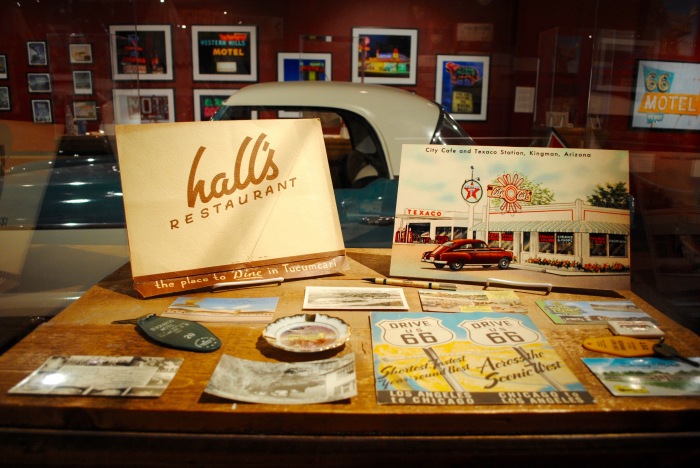
••• A temporary exhibit (through October 2, 2016) celebrates the “mother road” of Route 66, especially its impact on Arizona. On display are a couple of vintage cars and several paintings of nostalgic neon motel signs, as well as Route 66 ashtrays, postcards and other bric-a-brac. Listening carefully to a video, I found out that even though the advent of interstate highways spelled the end of several small towns along the route, the highway still holds a mystique for travelers willing to take the time to explore it.
••• An adjacent building called the Learning Center has displays of Arizona-made quilts, along with an area dedicated to Arizona’s state tie (for real!), the bola tie, which I never knew was derived from boleadora, an Argentine cattle roping tool designed with braided leather.
Perhaps writing about an Arizona heritage museum doesn’t require the same level of introspection about purpose and audience as does writing about little-known cultures of the world, especially those off the beaten path of American and Western travelers. But it’s a start toward having those “meta-conversations” that Lisle recommends. Whenever I next embark on foreign travel — and get out of the desert heat — hopefully I will ask myself not only, “How am I representing ‘otherness’?” but also, “Why am I here?” and “Whom should I talk to?” From these acts of self-reflection, my writing stands a chance of effecting a change in perceptions, regarding whomever and whatever I’m chronicling.


